
Evidence of Impact
Institutions hire me when community engagement has to produce documented outcomes, not just participation numbers. These case studies show how participatory visual methods can support trust, visibility, research, recognition, and continuity across public-facing institutional work.
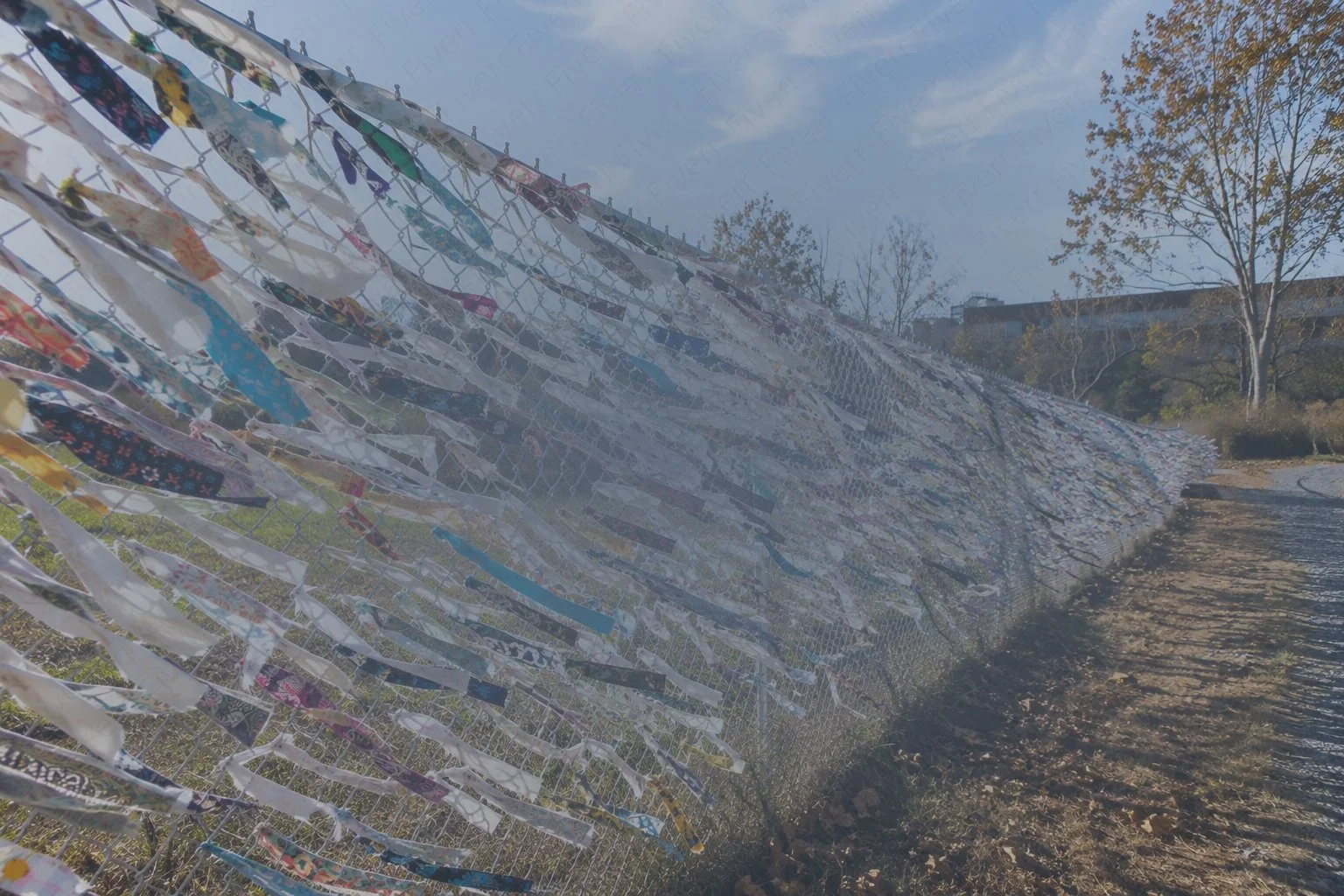
The Ties That Bind Asheville
CONTEXT
Participatory public installation
Asheville’s River Arts District, NC
173 days (May–November 2025)
Post-Tropical Storm Helene recovery context
PARTNER SITES
Local Cloth · Warren Wilson College Environmental Summit · Allon Health & Wellness
Challenge & Need
Communities recovering from Tropical Storm Helene needed structured, ongoing opportunities for collective grief, care, and connection — but sustained facilitation is resource-intensive and difficult to maintain across a long recovery timeline. The challenge was designing a public engagement structure that could remain active and meaningful without requiring continuous professional oversight.
Methodology
A durational participatory installation was anchored on a riverside fence in Asheville’s River Arts District. The designed participation structure invited community members to tie repurposed fabric strips to the fence, attaching personal text and objects — creating a growing collective visual record of care, memory, and connection. The structure was designed for independent operation: accessible to a wide range of participants regardless of age, ability, or prior engagement with public art, and requiring no ongoing facilitation to sustain activity after installation.
The project grew into a modular, city-wide practice through off-site activations at partner sites — including Local Cloth, Warren Wilson College’s Environmental Summit (during Thrive Asheville’s recovery-research launch), and Allon Health & Wellness — with materials gathered at each site returned to the primary riverside installation to maintain continuity across locations.
Outcomes
173 days of active, independently sustained community participation across arts, academic, and wellness environments. Emergent stewardship by community members who extended and protected the work without prompting. Documented evidence of grief, memory, care, and belonging made visible across recovery phases. Demonstrated that a single designed participation structure can sustain meaningful civic engagement across a long recovery timeline without continuous facilitation overhead.
Procurement / Partnership Relevance
Demonstrates community engagement continuity in practice: a designed participation structure that produces qualitative community engagement outcomes across a long public timeline without continuous facilitation overhead. The modular structure and partner-site model shows how engagement can extend across institutional contexts — relevant to disaster recovery programs, CHNA community engagement requirements, long-cycle planning processes, and grant-funded programs where community contact cannot go quiet between formal phases.
Many Hands, Light Work
Permanent modular installation
Medical University of South Carolina
Colbert Library exterior wall, Charleston, SC
Completed 2025
Partners:
Patient and Family Advisory Council (commissioning body) · MUSC Arts in Healing · Earthbuilt (rammed earth tile fabrication)
Challenge & Need
MUSC needed a permanent public artwork for a high-traffic exterior wall that could celebrate the diverse student body, make relationships of giving and receiving care visible, and withstand future coastal storms — coordinated across institutional stakeholders including the Patient and Family Advisory Council, MUSC Arts in Healing, facilities, and administration.
Methodology
A modular tile system using hand-painted rammed earth — selected for durability, climate resilience, and its visual resonance with the Low Country landscape. Hand imagery was developed as the conceptual anchor, reflecting the human connections at the heart of healthcare and the dual nature of giving and receiving care. Rammed earth tiles were fabricated by Earthbuilt, a subcontractor specializing in sustainable construction techniques, bringing climate-resilient materials into an institutional art context. The work moved through multi-phase institutional review and approval before installation on the Colbert Library’s exterior wall, at a crossroads of student life and clinical care.
Outcomes
Permanent installation in place on the Colbert Library exterior wall. Serves as a daily landmark and point of reflection for students and staff at a crossroads of academic learning and clinical care. Demonstrated how sustainable construction techniques (rammed earth) can be introduced into institutional public art contexts. Successfully coordinated through multi-phase institutional review, subcontractor fabrication, and site installation within a major academic medical center.
Procurement / Partnership Relevance
Demonstrates capacity to manage institutional timelines, multi-stakeholder approval processes, subcontractor coordination, and permanent implementation within a major academic medical center. Relevant to health systems, hospital campuses, and institutional partners evaluating permanent commissioned work, visual engagement programs, or arts-in-health partnerships.
Energetic Exchange
Community-based participatory research and practicum
Lake City, SC
Rural public health context
University of Florida Center for Arts in Medicine
2022–2024
Partners:
ArtFields · Greater Lake City Community Resource Center · Lake City Senior Center · Main Street Elementary School of Arts · University of Florida Center for Arts in Medicine
Challenge & Need
Rural communities with high rates of Type 2 diabetes face compounding systemic challenges — transportation barriers, food insecurity, limited access to non-clinical health supports — that make imported mindfulness models poorly suited to local conditions. The research question was whether low-cost, participatory art could function as an acceptable mindfulness-based health intervention in this context, and under what conditions communities would sustain involvement.
Methodology
Practicum (2022): In partnership with ArtFields and the Greater Lake City Community Resource Center, hybrid sessions combined remote instruction with on-site facilitation. Elders, schoolchildren, and adults engaged in mindful handwork by twisting fabric strips into cordage. A proof-of-concept twine mural was independently constructed using repurposed cordage, first installed at ArtFields and later relocated to the Greater Lake City Community Resource Center.
Capstone Research (2023): Qualitative surveys with 31 Lake City residents assessed the potential of mindful public art as a health intervention. Participants were diverse in age and background, many navigating systemic health challenges. Grounded theory methodology and Atlas.ti systematic coding were used to analyze findings across three themes: stress reduction and confidence; community connection; and access and equity.
Policy Brief (2024): Findings were synthesized into practitioner-facing recommendations framing mindful public art as a replicable, low-cost health strategy. The brief emphasizes creative reuse, community leadership, and cultural responsiveness as conditions for sustainability in rural contexts.